


When a tightened spec produces parts at half the yield, the shop didn't get worse. The spec moved past what the supplier's process can produce — at the design table, before the part ever hit the bench. The tightening looked free on the print; the cost arrives at first article inspection as yield loss for the parts that don't meet the tightened requirement.
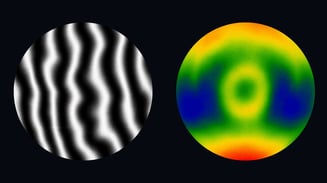 Surface irregularity is among the most frequently tightened parameters on optical drawings. The assumption is that a tighter specification reliably buys better system performance. Past the system's wavefront sensitivity threshold, it does not; further reductions deliver diminishing returns, and cost rises when the spec proves unverifiable or unmanufacturable at the supplier's process window.
Manufacturability shapes the design space; it is not a downstream consequence. A tolerance choice that produces parts is a design parameter; one that doesn't is a design failure that surfaces only at first article. DFM applies in the designer's cube, not just at the assembly bench. The discussion below walks the discipline through to a defensible per-surface allocation.
What Surface Irregularity Describes
Surface irregularity is the residual deviation of a fabricated optical surface from its intended form, whether spherical, plano, or aspheric, and is governed by ISO 10110-5.1 The departure is quantified in fractions of a test wavelength, and naming the wavelength is part of the specification. Two wavelengths cover practice: 632.8 nm HeNe for interferometric measurement and 546.07 nm mercury green for traditional test-plate work. A tolerance of "λ/4" with no named wavelength is a tolerance the supplier cannot certify.
Typically, two metrics describe the residual surface figure error, i.e., the "irregularity". Peak-to-valley reports the extreme excursion across the aperture as the difference between the highest and lowest points; it represents only two points. Root mean square (RMS) reports the square root of the mean of squared deviations across the entire aperture, tracking system performance more closely than peak-to-valley.2
A note on the terms used. "Irregularity" peak-to-valley and RMS conventionally describe the low-spatial-frequency content below roughly 0.1 mm−1. Irregularity is often described in terms of traditional aberration terms like "Spherical Aberration" and "Astigmatism," which are components of irregularity that apply across the entire optical aperture. Mid-spatial-frequency (MSF) content from 0.1 to 10 mm−1 (slope error and the power-spectral-density regime) and roughness above 10 mm−1 (governed by ISO 10110-8) degrade optical performance through different mechanisms: MSF content produces small-angle scatter and ghost imaging; roughness produces wide-angle scatter. They are governed by separate specifications.3 This piece concerns the figure band.
Wavefront Measurement and Surface-to-Wavefront Propagation
Within the figure band, two methods verify irregularity in practice. The classical method is the test plate, a reference flat or sphere placed in contact with the part under monochromatic illumination, generating Newton's rings-style fringes the inspector counts and interprets. The modern method is interferometric wavefront measurement; transmitted-wavefront tolerances are specified per ISO 10110-14.4 The interferometer reconstructs the wavefront returned from the surface, then mathematically subtracts piston, tilt, and power, isolating the residual surface deviations as the irregularity component.5
The numerical relationship between the surface deviation and the wavefront deviation it produces is not unity. A reflective surface displaced by δ contributes 2δ to the reflected wavefront; the light traverses the displacement twice. A transmissive surface with the same δ contributes (n−1)δ to the transmitted wavefront at normal incidence; for a typical glass at n ≈ 1.5, that is, half the surface departure rather than twice it. At non-normal incidence, the paraxial contribution is (n−1) cos φ δ, with φ the chief-ray angle of incidence. Conflating surface departure with wavefront contribution is a recurring source of overspecification; the propagation factor (2 for reflection, (n−1) for transmission) is what lets the engineer convert between them without writing the system wavefront target as a surface form spec.6
|
Overspecifying tolerances is a common issue in precision optic design.But Ross Optical can help your team determine the best specifications for high performance and low manufacturing costs. Explore our Tolerancing Guide to find out more.
|

Why Surface Position Matters as Much as Tolerance Value
Optical surfaces do not contribute equally to system wavefront error, even when they carry the same λ-fraction figure tolerance. What matters at a given surface is the figure within the subaperture each ray bundle intersects, not the full-aperture irregularity. The relevant subaperture, the footprint, is a standard output of optical design software: the FOOTPRINT operand in CodeV, the footprint diagram in OpticStudio.7
Pupil-conjugate surfaces (at or near the aperture stop or any image of it) have footprint D ≈ 1; image-conjugate surfaces have D ≪ 1. The chief-ray and marginal-ray construction in Figure 1 makes the geometry explicit: each field point's bundle fills the entire surface at a pupil conjugate but reduces to a focused spot at an image conjugate.8 At a pupil conjugate, figure error imprints on every field's wavefront, and the per-surface tolerance is the binding constraint on the system wavefront budget. At an image conjugate, figure error affects only the field points whose footprints cross it, and the per-surface tolerance can relax by a factor of order 1/D at the worst field for the same contribution to system wavefront RMS.
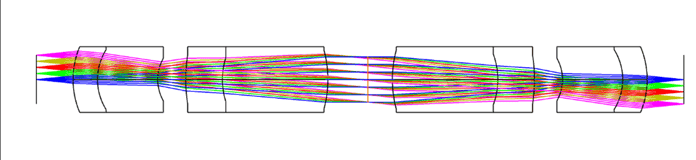
Real systems embed this geometry in their relay architecture, alternating conjugate position from one surface to the next. In a rod-relay endoscope, surfaces at the field stops and the aperture stop alternate in conjugate position through the relay group; figure tolerance follows the geometry rather than the surface count.9 The operational consequence: tighter figure tolerance belongs near apertures, not near image planes. The same nominal λ/N spec means different things at different surface positions.
Multi-Surface Aggregation and the System Threshold
Most systems are not single surfaces. For uncorrelated, zero-mean wavefront errors contributed by N surfaces in series, the variances add (RSS aggregation): σsystem2 = Σi σi2. For N identical surfaces with equal wavefront RMS σ each, σsystem = σ√N. To meet a system specification σtarget, the per-surface wavefront allocation is σtarget/√N, substantially tighter than the system criterion alone implies.10 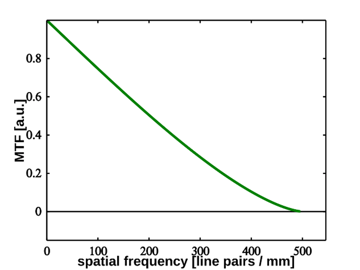
A system delivers MTF approaching the diffraction-limited curve when its total wavefront RMS sits at or below approximately λ/14. The diffraction-limited reference curve [F-D — Wikipedia, "Optical transfer function," https://en.wikipedia.org/wiki/Optical_transfer_function, CC-BY-SA] is the upper bound that any real system approaches; below the λ/14 threshold, further tightening yields negligible MTF improvement.11 For a 10-surface visible-band rod-lens relay at internal-relay NA 0.1 to 0.2 (632.8 nm), the per-surface wavefront RMS budget at the diffraction-limited threshold is approximately λ/44, equivalent to surface form RMS near λ/22 in n = 1.5 crown glass.
Camera-pixel-sampling-limited systems (medical endoscopy is the typical case, where sensor pitch caps system MTF before the optics do) operate against a looser system wavefront RMS threshold of λ/8 to λ/4 per ISO 8600-5 Characteristic C.12 At a λ/8 system wavefront target, the per-surface budget for the same 10-surface relay runs near λ/25 wavefront RMS, equivalent to surface form RMS near λ/12 in n = 1.5 crown glass.
A Worked Example: Cost-Aware Tolerance Allocation
Take the relay's two-doublet building block, eight of the ten surfaces from §5, operating at the camera-pixel-limited regime (ISO 8600-5). Three allocation strategies for the figure tolerance on those surfaces, scored on cost-per-passing-endoscope (cost = polishing-labor-per-set ÷ system pass yield).13 Dollar figures are illustrative within documented process-capability bands; the structural comparisons are what carry.
Uniform λ/8 baseline. Write the system wavefront target onto every surface as surface form. The four field-conjugate surfaces sit at the edge of manufacturability at their steep curvatures; the four pupil-conjugate surfaces are over-specified for their footprint. At ~$500/set, first-pass yield ~50% → ~$1,000 per passing endoscope.
Uniform λ/16 — the reflexive tightening. Tighten further at every surface to escape the yield-loss regime. Polishing labor rises to ~$750/set; system yield improves to ~77% as per-surface variance contributes less to system rejection. Cost-per-passing-endoscope runs ~$975, which barely moves. The ~2.5% gain comes at higher manufacturing risk on the steep field surfaces, with zero MTF improvement.
Surface-by-surface. The four pupil-adjacent surfaces are gentler in curvature (high optical leverage, low manufacturing difficulty); the four field-conjugate surfaces are steeper (low leverage, high difficulty). Hold pupil-adjacent at λ/16; relax field-conjugate to λ/2 (commercial polish at the natural process band). Polishing labor stays flat at ~$500/set as the cost increase on the four tight surfaces offsets the decrease on the four loose ones; weighted yield rises to >90% with every surface inside its supplier's process window. Cost-per-passing-endoscope ~$550: a 45% reduction at the same MTF. Element-class weighting amplifies further; a coated aspheric typically prices at 4–5× a flat plano window.
Two inputs combine for the allocation: optical-design footprint analysis at every surface (the OEM's engineer has this), and per-supplier yield-vs-tolerance curves across the network (Ross maintains these across the 21-supplier global network for 3 to 150 mm and POC Gardner's sub-3 mm micro-precision tooling). A Ross design-partner engagement combines the two and lands the per-element tolerance assignment that minimizes cost-per-passing-endoscope at parity MTF.
Defect Tolerances Tighten Toward the Image
Surface figure and surface defects (scratches and digs per ISO 10110-7) are different physical quantities, and they tighten in opposite directions across pupil and image conjugates. Where figure tolerance tightens toward the pupil because that is where the bundle fills the surface, defect tolerance tightens toward the image plane because that is where the defect itself is sharply imaged. Conflating the two on a print produces overspecification on one set of surfaces and underspecification on the other.14
A scratch or dig is a localized opacity, not a phase error. A scratch or dig at an image-conjugate surface produces a sharp dark spot or line in the final image; at a pupil-conjugate surface, the same defect produces only a small uniform fractional throughput loss across the field. This reversal follows from the imaging-conjugate relationship between the defect's position and the focal plane, codified in the ISO 10110-7 acceptance-level structure.15
The operational rule: scratch-dig tolerances of 60-40 are typical at pupil-conjugate or out-of-focus surfaces; 20-10 or 10-5 is reserved for image-conjugate or near-focal-plane surfaces, the windows immediately ahead of the sensor, splitters near the focal plane, and filters at intermediate image planes. ISO 10110-7 distinguishes functional from cosmetic effects in its acceptance-level structure; MIL-PRF-13830B and ANSI/OEOSC OP1.002 use the same tier convention.16 Pairing tight figure tolerances near pupil conjugates with tight defect tolerances near image conjugates gives the print a complete surface-quality discipline.
Best Practices for Specifying Irregularity
Tighter tolerances do not reliably produce better systems; well-allocated tolerances do. The rules below summarize how a Ross design-partner engagement allocates tolerance within the supplier's process capability across a customer's full lens stack. Each rule consolidates a finding from the prior sections; together, they form a checklist for irregularity specification on a print bound for an outside supplier.
- Name the test wavelength on every λ-fraction tolerance. Without it, the print is unenforceable.
- Choose the λ-fraction tier from the application's actual MTF requirement, not from an industry default. The diffraction-limited threshold is rarely the same as a camera-pixel-sampling-limited threshold.
- Allocate per-surface wavefront tolerances by RSS aggregation, with σsystem = σ√N as the check. The per-surface budget is always tighter than the system criterion alone implies.
- Tighten figure toward the pupil and loosen toward the image. Footprint geometry decides; the linear-D approximation is conservative because surface-figure content typically resides at radial polynomial order n ≥ 2 (defocus, astigmatism, coma, fourth-order spherical), where Dn ≤ D for D ≤ 1.17
- Tighten defects toward the image and loosen toward the pupil. Scratches and digs are opacity, not phase, and their imaged sharpness depends on conjugate position in the opposite direction from figure error.
- Verify the metrology floor and the reference flat ladder before specifying. A spec tighter than the metrology that will measure it is unenforceable.
Closing
The discipline above produces prints that yield parts the system needs at a price the program can absorb. Customers engaging Ross only as a supply partner receive components from the 21-supplier global network (3 to 150 mm) and POC Gardner's sub-3 mm micro-precision tooling. Ross holds ISO 9001:2015 and is ITAR registered; POC operates under ISO-13485. Customers engaging Ross as a design partner receive the per-element tolerance assignment behind the print: conjugate-position-aware figure-and-defect allocation, screening against the metrology floor and supplier capability, and a DFM review that, before the print leaves engineering, flags tolerances driving cost without performance gain.
Schedule a Collaborative DFM review with Ross Optical Engineering. Bring your draft drawing and the system specification. We will identify the irregularity specifications that buy performance, the ones that only buy cost, and the per-surface allocations the supplier network can certify against the metrology floor that will measure them.

References
1. International Organization for Standardization, Optics and Photonics — Preparation of Drawings for Optical Elements and Systems — Part 5: Surface Form Tolerances, ISO 10110-5:2015 (Geneva: ISO, 2015).
2. Warren J. Smith, Modern Optical Engineering: The Design of Optical Systems, 4th ed. (New York: McGraw-Hill, 2007), ch. 11.
3. James H. Burge, "Specifying Optical Components," lecture 11 of OPTI 421/521, Introductory Optomechanical Engineering, College of Optical Sciences, University of Arizona, accessed May 6, 2026, https://wp.optics.arizona.edu/optomech/wp-content/uploads/sites/53/2016/08/10-Specifying-optical-components.pdf; International Organization for Standardization, Optics and Photonics — Preparation of Drawings for Optical Elements and Systems — Part 8: Surface Texture; Roughness and Waviness, ISO 10110-8:2019 (Geneva: ISO, 2019).
4. International Organization for Standardization, Optics and Photonics — Preparation of Drawings for Optical Elements and Systems — Part 14: Wavefront Deformation Tolerance, ISO 10110-14:2018 (Geneva: ISO, 2018); David Anderson and James H. Burge, "Optical Fabrication," in Handbook of Optical Engineering, ed. Daniel Malacara and Brian J. Thompson (New York: Marcel Dekker, 2001).
5. Smith, Modern Optical Engineering, ch. 15.
6. Burge, "Specifying Optical Components"; Smith, Modern Optical Engineering, ch. 15; ISO 10110-5:2015; ISO 10110-14:2018.
7. Burge, "Specifying Optical Components"; Smith, Modern Optical Engineering, ch. 15.
8. John E. Greivenkamp, "Stops and Pupils," section 10 of OPTI 201/202, Optical Engineering and Instrumentation, College of Optical Sciences, University of Arizona, accessed May 6, 2026, https://wp.optics.arizona.edu/jgreivenkamp/wp-content/uploads/sites/11/2018/12/201-202-10-Stops-and-Pupils.pdf; Burge, "Specifying Optical Components," slide 21; Virendra N. Mahajan, Optical Imaging and Aberrations, Part II: Wave Diffraction Optics, 2nd ed., SPIE Press Monograph PM209 (Bellingham, WA: SPIE Press, 2011).
9. Jan Hoogland and John K. Landre, Endoscope Relay Optics, U.S. Patent 4,946,267, issued August 7, 1990, https://patents.google.com/patent/US4946267A/en.
10. Max Born and Emil Wolf, Principles of Optics: Electromagnetic Theory of Propagation, Interference and Diffraction of Light, 7th expanded ed. (Cambridge: Cambridge University Press, 1999), §9.1.3; Smith, Modern Optical Engineering, ch. 15; ISO 10110-14:2018.
11. Wikipedia, s.v. "Optical Transfer Function," accessed May 6, 2026, https://en.wikipedia.org/wiki/Optical_transfer_function; Born and Wolf, Principles of Optics, §9.1.3; Mahajan, Optical Imaging and Aberrations, vol. II.
12. International Organization for Standardization, Optics and Photonics — Medical Endoscopes and Endotherapy Devices — Part 5: Determination of Optical Resolution of Rigid Endoscopes with Optics, ISO 8600-5:2020 (Geneva: ISO, 2020).
13. Burge, "Specifying Optical Components"; David Anderson and James H. Burge, "Optical Fabrication," in Handbook of Optical Engineering, ed. Daniel Malacara and Brian J. Thompson (New York: Marcel Dekker, 2001). Process-capability bands and yield-vs-tolerance discussion supporting the cost-tier mapping. Cost-per-passing-endoscope is taken as polishing-labor-per-set ÷ system-level pass yield, applying the standard cost-per-success accounting model where setup and operator labor dominate per attempt. The dollar values are illustrative within the documented process-capability bands; per-engagement values vary by supplier-network and per-shop economics.
14. ISO 10110-5:2015; International Organization for Standardization, Optics and Photonics — Preparation of Drawings for Optical Elements and Systems — Part 7: Surface Imperfections, ISO 10110-7:2017 (Geneva: ISO, 2017).
15. Wikipedia, s.v. "Surface Imperfections (Optics)," accessed May 6, 2026, https://en.wikipedia.org/wiki/Surface_imperfections_(optics); ISO 10110-7:2017.
16. U.S. Department of Defense, Performance Specification: Optical Components for Fire Control Instruments, MIL-PRF-13830B (Washington, DC: DoD, January 9, 1997); American National Standards Institute and Optics and Electro-Optics Standards Council, Optical Elements and Assemblies — Surface Imperfections, ANSI/OEOSC OP1.002 (Charlotte, NC: OEOSC, latest issue); David M. Aikens, "The Truth About Scratch and Dig," in International Optical Design Conference and Optical Fabrication and Testing, OSA Technical Digest CD (Washington, DC: Optica Publishing Group, 2010), paper OTuA2.
17. Vladimir Sacek, "Zernike Aberration Polynomials," section 3.5.2 of Amateur Telescope Optics, accessed May 6, 2026, https://www.telescope-optics.net/zernike_aberrations.htm.