


Understanding the Fundamentals of 4f Systems
The 4f optical configuration shows up in many applications, from microscopy and semiconductor fabs to laser beam shaping and adaptive optics. Yet despite its widespread use, many engineers and system designers encounter only fragments of its capabilities in application-specific contexts.
At its core, the 4f system is deceptively simple: two optical elements arranged so that their separation equals the sum of their focal lengths. But this arrangement unlocks powerful capabilities in image relay, Fourier-domain manipulation, spatial filtering, pupil conjugation, and beam shaping that have shaped decades of optical innovation. We’ll explore why this decades-old configuration remains essential across industries today.
For the complete technical deep dive, including implementation strategies, aberration management, reflective vs. refractive designs, and advanced applications, you can download the full e-book.

What is a 4f Optical Configuration?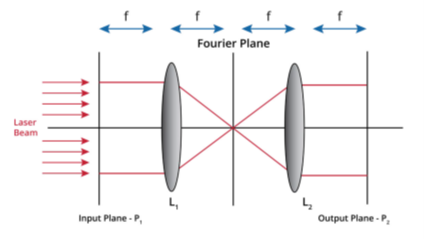
The term “4f” comes from the geometry of the system itself. In the simplest arrangement, two identical lenses with focal length f are spaced 2f apart, with the object and image planes positioned one focal length away from each lens.
This setup creates a unique optical condition that satisfies the imaging condition for both lenses simultaneously:
- The first lens converts the object into its spatial frequency representation at the Fourier plane.
- The second lens reconstructs the image from those spatial frequencies
That intermediate Fourier plane is what makes the 4f configuration so powerful. Instead of only manipulating an image directly, engineers can selectively modify spatial frequency information, enabling filtering, beam shaping, aberration correction, and optical signal processing.
Because of this dual-domain access, 4f systems have become foundational in applications ranging from relay optics to optical computing to target recognition systems.
How 4f Systems Were Developed
The origins of the 4f configuration trace back to the late 19th century, when Ernst Abbe demonstrated that microscope image formation could be understood through diffraction and spatial frequencies rather than purely geometric optics.
Later, Fourier optics researchers formalized the Fourier optics theory that explained how a lens performs a Fourier transform of an incoming optical field. This established the mathematical framework for the modern 4f arrangement.
One of the most influential demonstrations came in 1906 through Albert B. Porter’s spatial filtering experiment. Using a basic 4f arrangement, Porter placed masks at the Fourier plane and showed that horizontal and vertical features could be selectively removed by blocking corresponding spatial frequency components.
That experiment foreshadowed many technologies that would emerge decades later, including:
- Optical image processing
- Laser beam shaping systems
- Holography
As laser technology matured in the 1960s and beyond, the 4f system evolved from a laboratory concept into an industrial workhorse in semiconductor manufacturing, telecommunications, biomedical imaging, defense and security, etc.
The Key Advantage: Simultaneous Access to Image and Fourier Domains
What separates the 4f configuration from many traditional optical layouts is its separation of spatial and spatial-frequency representations, allowing direct manipulation of Fourier-domain information while still performing image-space relay within the same optical system.
This enables several critical functions:
Spatial Filtering
By placing apertures or masks at the Fourier plane, unwanted spatial frequencies can be removed or enhanced. This is the basis for many image enhancement and beam conditioning techniques.
Pupil Relay
The system can relay both the image plane and the pupil plane simultaneously, making it valuable in scanning systems and adaptive optics.
Aberration Control
The symmetric nature of the optical configuration inherently provides some aberration compensation, but design considerations are still necessary to ensure complete aberration control in advanced applications.
Through careful optical design, the 4f configuration can be adapted for refractive or reflective systems and tailored to support a broad range of imaging, filtering, and beam‑shaping functions. [Link to Landing Page]
Where 4f Optical Systems Are Used Today
Modern optical systems rely on 4f architectures in far more places than many engineers realize. The e-book explores these applications in depth, but several stand out for their industry impact.
Microscopy and Biomedical Imaging
Confocal microscopy systems use 4f relay optics to maintain pupil conjugation and uniform illumination across the imaging field. Structured illumination microscopy (SIM) systems similarly rely on Fourier-plane access to generate precise illumination patterns.
Laser Materials Processing
Industrial laser systems use 4f relays for beam delivery, telecentric scanning, and beam shaping. In many cases, these systems achieve highly uniform beam profiles with efficiencies exceeding 90%.
Semiconductor Manufacturing
Photolithography and wafer inspection systems use cascaded 4f relays to control illumination uniformity, spatial filtering, and defect detection performance at nanometer scales.
Telecommunications
Wavelength-selective switches (WSS) and optical pulse shaping systems use 4f configurations for spectral filtering and signal routing in fiber-optic communication systems.
Astronomy and Adaptive Optics
Modern telescopes employ 4f relay systems in wavefront sensing and adaptive optics architectures to compensate for atmospheric distortion in real time.
Defense and Security Applications
Military and security systems utilize the 4f configuration for real-time pattern matching in target recognition systems and beam expansion and collection optics in laser range finding and designation.
The Future of 4f Optical Design
The 4f configuration continues to evolve alongside advances in manufacturing and computational optics.
Looking ahead, emerging technologies are innovating on 4f architectures, such as:
- Metasurface-based ultracompact 4f systems
- Computational imaging architectures
- AI-assisted optical optimization
- Integrated photonics
- Quantum imaging systems
- Additive manufacturing for optical assemblies
Download the Full E-Book
This article only scratches the surface of what modern 4f optical systems can achieve.
Our full e-book explores:
- Mathematical foundations of the 4f configuration
- Refractive and reflective system architectures
- Aberration management techniques
- Real-world implementation strategies
- Performance optimization methods
- Industry-specific application examples
- Emerging technologies shaping the future of 4f optics