


Key Takeaways:
- Standard optics allow engineers to rapidly prototype and validate semiconductor inspection concepts.
- Catalog components help reduce development risk, shorten design cycles, and lower upfront engineering costs.
- Once performance requirements are established, custom optics can optimize throughput, resolution, and manufacturability.
- Ross Optical supports development from prototype through production with engineering, fabrication, coating, assembly, and inspection services.
Standard Optics as a Foundation for Prototyping
 The semiconductor market is evolving rapidly into a production-scale growth phase. The semiconductor inspection market alone is estimated at $10-15 billion USD in 2026 at a 7%-10% CAGR, with investments in new fabrication facilities, advanced packaging technologies, wafer inspection, and next-generation process nodes. At the same time, designers must develop systems that detect increasingly smaller defects and maintain high throughput and reliability while speeding time to market to meet industry demands.
The challenge is that inspection system developers might assume a custom optical design is required when prototyping. While custom optics often play a role in final inspection systems, many successful designs begin with standard (catalog) optical components. Using commercially available optics during the early stages of development allows engineers to validate concepts, refine system requirements, and accelerate time-to-market before committing to high-cost, custom optical designs.
Ross Optical has one of the largest selections of optics and optical components available in the industry.

Time-to-Market Matters in Inspection System Development
The semiconductor industry moves in product cycles measured in months rather than years. Equipment manufacturers must rapidly prototype concepts, validate performance, and prepare systems for production deployment, but design iterations on custom optics often prolong prototype timelines.
One of the most expensive mistakes teams can make is over-specifying optical requirements before validating actual application needs. We often advise designers to fully understand the end-use requirements of an optical system before establishing performance specifications that may increase cost and complexity unnecessarily.
Often, designers can evaluate and prototype systems with standard optics before introducing custom components into the mix. Catalog optics help engineers:
- Evaluate system feasibility earlier
- Reduce custom iterations and development risk
- Accelerate prototype builds
- Simplify procurement
- Decrease upfront engineering costs
This allows teams to focus their resources on solving inspection challenges rather than reinventing optical subsystems.
Where Standard Optics Shine in Semiconductor Inspection
Does the system achieve the required resolution? Is the field of view adequate? Are defects being detected reliably? Engineers need to answer these questions early on in development.
The Hidden Advantage: Faster Iterations
One advantage is sometimes overlooked: Availability.
Catalog optical components provide an efficient way to validate these requirements before investing in a custom solution. Rather than waiting for custom optics to be manufactured, engineers can assemble test systems quickly and begin evaluating performance and design constraints almost immediately. Ross Optical specializes in sourcing hard-to-find optics through our global supply chain.
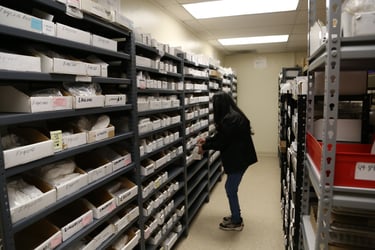 Using off-the-shelf optics speeds up timelines for:
- Imaging evaluations
- Sensor selection
- Illumination optimization
- Algorithm training
- Defect detection validation
- AI model development
This development strategy can be used across wafer inspection, packaging, defect detection, machine vision test platforms, and more for proof-of-concept testing, positioning, and software training. For example, with semiconductor fabs integrating machine learning and automated detection algorithms, having prototyped imaging hardware available earlier allows software teams to build and train inspection models sooner.
After prototyping, many teams determine that they need custom optical components to meet specific performance requirements. Ross can fabricate custom lenses from under 1 mm to over 150 mm in diameter.

Key Optical Components Commonly Used in Inspection Prototypes
For many semiconductor OEMs, this approach is not about choosing between standard and custom. It combines both in a staged process.
Start with proven standard optical components — validate the architecture, verify performance targets, and accelerate prototype development. Once system requirements are fully understood, move on to custom components to meet performance needs that standard optics can’t reach.
By leveraging catalog lenses, filters, beam splitters, and illumination optics, engineers can accelerate prototyping while reducing risk and controlling costs.
| Catalog Optic | Key Benefits | Applications |
| Achromatic Lenses | Minimize chromatic aberration and improve image quality across multiple wavelengths | Multi-wavelength imaging, metrology, high-precision measurement systems |
| Optical Filters | Enhance image contrast and isolate specific wavelengths to improve feature visibility | Defect detection, process monitoring, surface inspection, fluorescence-based analysis |
| Beam Splitters | Divide or combine light paths for simultaneous imaging and measurement functions | Metrology systems, alignment systems, multi-sensor inspection platforms |
| Optical Windows | Protect sensitive sensors and optical assemblies while maintaining optical performance | Inspection systems operating in cleanroom and wafer-processing environments |
| Cylindrical Lenses | Shape light into lines for scanning and measurement applications | Line-scan inspection systems, laser-based measurement and positioning systems |
Prototyping Case Study
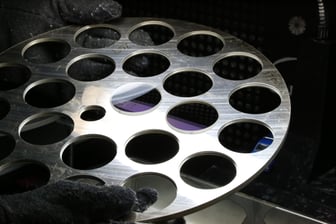 Developing optical prototypes often involves several rounds of redesign. When PhotoKinetics needed prototype profiles with custom filter coatings for a wavelength-blocking medical device, Ross Optical delivered two successful solutions on the first attempt, helping the company streamline development and bring its product to market faster.
- Challenge: Help an R&D company select from 23 proposed designs and prototype best bets
- Solution: Two filter coating profiles, one inexpensive and one exacting and elegant
- Result: Two correctly working prototypes the very first time, ready for field tests
Partner with Ross Optical from Prototype to Production
Many high-performance optical systems begin with standard components and evolve into customized solutions as requirements become more defined. Evaluating a new semiconductor inspection concept or preparing for production-scale deployment? Ross Optical can help identify the right optical strategy at every stage of development through engineering, fabrication, coating, assembly, and inspection support.